I Got 99 Problems But the PMO Ain't One (hit me!)
Why projects don't die from governance - they die from lost belief.
In 2003, Jay-Z gave us one of the most misunderstood hooks in hip-hop. "99 Problems" isn't a flex. It isn't someone sailing through life untouched by difficulty. Listen properly and it's a story about racial profiling, legal jeopardy, industry enemies, and the constant pressure of systems designed to work against you.
In his book Decoded, Jay-Z explains that the hook is a deliberate double entendre - each verse using the same word to mean something different. The song is far denser than its catchiness suggests.
The hook isn't dismissing problems. It's saying something far more precise: amid all of this genuinely serious, life-defining weight - a petty, trivial problem doesn't even make the list.
That distinction matters. And it's the one most people miss.
I want to borrow that energy for a minute because I've spent decades watching brilliant, dedicated Project Managers make exactly the same mistake in reverse. They've built extraordinary systems for managing the petty, trivial, administratively satisfying problems. And the genuinely consequential one... the one that actually ends projects - floats past them like a mine in a fog.
I got 99 problems but the RAID log ain't one
The RAID log matters. It's the backbone of governance. It shows discipline. It shows control. But think about the last project that really failed - not a minor wobble, a proper failure. Was the thing that killed it on the RAID log?
I'll wait.
It wasn't. It was the conversation that happened in a corridor you weren't in. The budget decision made in a room you weren't invited to. The Sponsor who quietly started referring to the project in the past tense three months before the official cancellation. The RAID log had forty-seven risks logged, scored, colour-coded and reviewed. The one that mattered wasn't in the file.
Risk #48: the one that sank the ship - was never logged.
I got 99 problems but the critical path ain't one
There's a special kind of suffering reserved for the Project Manager who has spent four days rebuilding a Gantt chart after a single dependency shift.
You know the feeling. Two hundred tasks moved. Three baselines reconciled. A revised critical path that is, technically, a work of art. And the deadline hasn't moved.
The critical path is a map. Maps don't sail ships.
A plan is a hypothesis, not a contract. The moment you defend the plan more fiercely than the outcome, you've confused the map for the destination.
I got 99 problems but the RAG status ain't one
Red. Amber. Green. Three colours responsible for more unnecessary anxiety in delivery organisations than almost anything else. We've all done it - Thursday afternoon, asking yourself whether something is really amber or whether you can justify keeping it green for one more week. Just until the steering committee. Just until Mercury is no longer in retrograde.
The dashboard showed clear skies. Below deck, the hull was cracking.
Green status isn't delivery confidence. Sometimes it's just a PM who's very good at formatting.
I got 99 problems but the methodology ain't one
Waterfall. Agile. SAFe. PRINCE2. PMP. Or the proprietary hybrid your organisation invented in 2019… and will quietly abandon by 2026 (Wagile anyone?). The methodology is a vessel, not a destination. And vessels only work if they fit the waters you're actually sailing.
I've watched Agile ceremonies become the most bureaucratic structures in an organisation. Sprints that feel like slow marches. Retrospectives where nothing is ever retrospected. Stand-ups where everyone is sitting down and the meeting runs forty-five minutes. The people clinging most rigidly to a framework called "Agile" are often the least agile people in the building.
I got 99 problems but the PMO ain't one
The PMO is not the enemy. Governance matters. Standards matter. Portfolio visibility matters enormously. But somewhere between that noble purpose and the seventeenth template request of the quarter, the original question gets lost. Not because of the people - because of the culture that builds up when process becomes the point rather than the means.
The best PMO I worked with asked every project the same question each month: "Is this still worth doing?"
Five words. Infinitely more valuable than a compliance checklist.
So what's the One?
The one problem that actually sinks projects isn't on the RAID log. It isn't on the dashboard. It isn't on the plan.
It's belief. And belief has two sides. Like a gold coin.
The Customer. And the Crew.
The Customer stops believing in the destination
Not dramatically. There's no angry email, no formal complaint. Just a quiet shift in the room - questions that used to be enthusiastic becoming politely sceptical. A stakeholder who used to lean forward now leans back. The thing you're building slowly drifts away from the thing they actually needed. When stakeholders start asking about exit options more than success criteria, belief is already thinning.
No RAG status captures that. No RAID log surfaces it. You only notice if you're paying the kind of attention that can't be delegated to a template.
The Crew runs out of road
Fatigue doesn't appear on a resource plan. Nobody logs a risk that reads "Team morale deteriorating - velocity about to collapse." But it shows up in the eyes before it shows up anywhere else; in the slightly shorter answers, the quieter meetings, the slow erosion of psychological safety you spent months building.
A good Captain doesn't wait for the retrospective to discover the Crew is exhausted. They read the ship. They notice when the energy changes. They ask questions that aren't on any survey:
How are you actually doing?
Is this sustainable?
What do you need that you haven't asked for?
These are leadership skills. Not administrative ones. Presence, not process.
And yes - both the Customer and the Crew carry responsibility here. Belief isn't passive. It has to be maintained, signalled, renewed. A Sponsor who quietly disengages without raising concern isn't leading either. But you can't control what they choose to do. You can only control whether you're paying attention.
Three habits that protect the gold
You don't need a new framework. Just three disciplines.
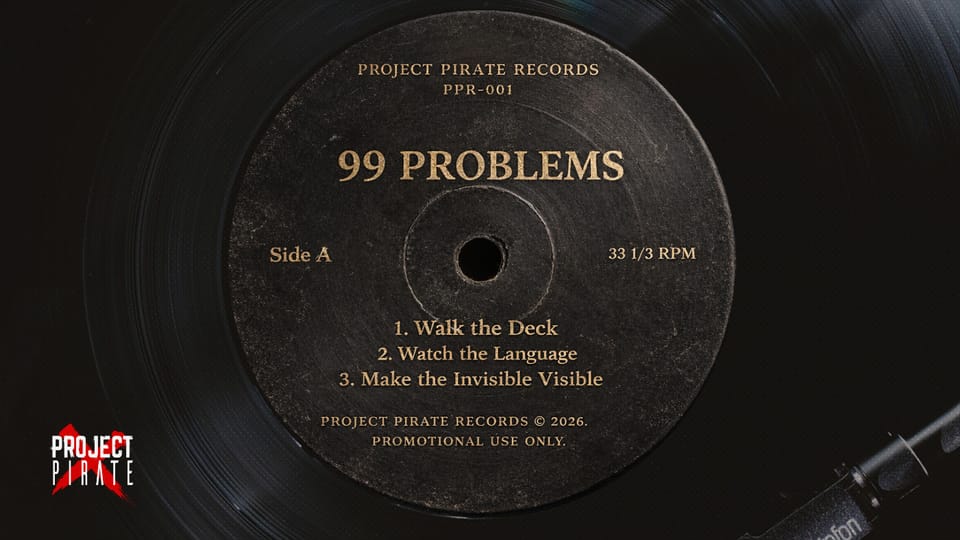
Walk the deck. Not with a status agenda - just curiosity. Fatigue hides from formal check-ins. It reveals itself in conversation.
Watch the language. When the Customer shifts from "when you deliver this" to "if you deliver this," something has changed. When a team member stops saying "we" and starts saying "they," something has changed too. Signals matter.
Make the invisible visible. Put two questions on your governance agenda - "How is the Crew?" and "Does the Customer still believe in the destination?" Not as metrics. As real conversations.
None of this is complicated. All of it gets skipped when the 99 are consuming every hour of every week.
The only register that really matters
Every operational problem has a place to live - a log, a tracker, a dashboard, a field in a system somewhere. Someone is responsible for updating it.
But the Customer's belief and the Crew's wellbeing live somewhere else entirely. In the spaces between meetings. In conversations that don't get minuted. In moments of human connection no dashboard was ever designed to capture - because, as I've explored before, the journey is the prize.
That's exactly why they sink ships.
I got 99 problems.
The RAID log ain't one.
The critical path ain't one.
The PMO ain't one.
The gold is your Customer and your Crew.
Two sides of the same coin.
Lose either…
…and the ship never makes it home.
Project Pirate · Loyal to No Fleet · United by the Storm 🏴☠️